
Friday

Thursday
Mount Kimbie - Before I Move Off
Directed by Tyrone Lebon
I love this video so much, I don't even know why? Something about it really struck a chord with me. I love the flickering photos which tell a story, even something like this could be something to think about for my title sequence.
Wednesday
Title sequence ideas
I want to take quite an illustrative route in my title sequence and avoid using film where possible. One idea I've had through browsing the internet is to create a large illustration which tells the story of Robin Hood or has objects relating to the story and filming it panning down/across. Using as little effects in post production as possible.


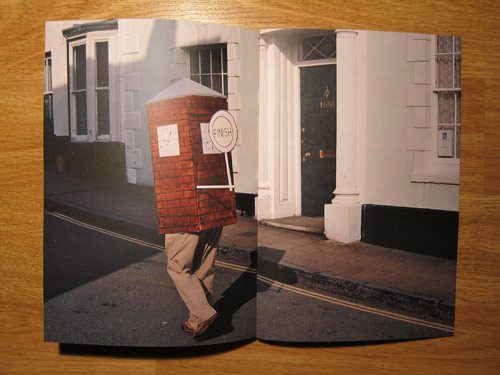
Another idea I've had to create a book which features the credits/objects etc and film the book being flicked through, like the beggining of Shrek, where the story is introduced through a storybook. However I'd like to take a more photographic/illustrative approach and possibly create an interactive book and film someone using it.
Rethink Scholarship at Langara 2010 Call for Entries from Rory O'Sullivan and Simon Bruyn on Vimeo.



Sunday
Metronomy - She Wants
Directed by Jul & Mat (www.juletmat.fr)
I like this video for its simplicity which makes for interesting viewing, as immediately you realise that what you're watching is being played backwards, however I didn't expect the scenes to turn, and I really liked this approach. The video itself feels like a continued, darker version of the bands previous video for A Thing For Me. Also the QR code featured as a poster within the video leads to a link to download the song for free, which is really clever and innovative as I haven't heard of that being done before.
Creep - Days
Directed by Warren Fischer
I love this video just for the effects used within it alone, alot of them would be so easy to recreate which I really want to try to do, I especially like the shots of the band members where they're covered in glitter. The mood of this video is perfect, trippy and dark.


Tuesday
Day 1 Filming - Emmanuel House


Some pretty intense shit going down...obviously.


Today was our first filming day for Emmanuel House, a
Patrick Kelleher & His Cold Dead Hands "Wintertime's Doll"
Label : Osaka records
Director : Sophie Gateau
This video is just amazing
Director : Sophie Gateau
This video is just amazing
Website plans
In an effort to get more of an online presence I've started to look into websites and hosting. I think I'm going to go with Indexhibit, as I've seen it used alot and although it's simple, it gets the job done and is customizable and versatile, as I'm hoping to not only have moving image in my portfolio, but also sketches, graphic work, paintings, a page which links through to this blog and possibly my tumblr blog too.
Monday
Research etc.
After getting in touch with Chloe Hayward for the short essay we were given I got a really helpful response basically telling me how she started, what she did in her course at uni and how she landed her current job and about her day to day role. She currently works for Intro, a design company based in London, where she is a junior director, and works in partnership mostly with Julian Gibbs. She began there as an apprentice straight from leaving uni and has worked her way up since. Lots of the work featured on her blog is through side projects for friends which she does alongside her job at Intro. Through speaking to her it's really helped me to get a focus on what I actually want from this course and also given me some inspiration for side projects to build up my portfolio.
Saturday
Compositor Job Role
Compositors work in most areas of animation and post production.
They are responsible for constructing the final image by combining layers of previously created material. Although it is primarily a 2D role within the 3D world of CGI and VFX (Visual Effects), Compositors need a thorough understanding of the CG process combined with relevant artistic skills.
In post production companies, some TDs (Technical Directors) may do their own compositing.
What is the job?
Compositors work at the end of the production process. They receive material from various sources which could include rendered computer animation, special effects, graphics, 2D animation, live action, static background plates, etc.
Their job is to creatively combine all the elements into the final image, ensuring that the established style of the project is respected and continuity is maintained.
To achieve this they enhance the lighting, match blacks and other colour levels, add grain where required, add motion blur (if appropriate), create convincing shadows and make sure levels combine together seamlessly, keying (see glossary), rotoscoping and creating mattes where necessary.
They work closely with Lighters and need to have technical knowledge of how 3D lighting works in order to understand the 'multi passes' that the lighters create. They also liaise closely with Render Wranglers to progress work through the department.
As this is the end of the production line, there can be occasions when it is necessary to work very long hours to catch up on a schedule. Compositors need to keep up to date with technological developments within their field.
Typical career routesCG Compositors are most likely to have entered the Compositing Department as Roto Artists and worked their way up. In other cases, people who have acquired an understanding of compositing in layers for 2D Animation, using programmes such as After Effects, Animo or Opus, may have the relevant experience.
There are several levels within the department; this job profile applies to a mid-level Compositor. With the appropriate talent and skills, Compositors can become Sequence Heads, Senior Compositors or Compositing Supervisors; the best Compositors can aim to become VFX Supervisors.
Essential knowledge and skills Compositors need the talent to make artistic judgements, the technical skills to take practical decisions and the ability to analyse and solve problems.
Key Skills include:
Compositors are likely to have gained a degree in an art-related subject, such as Animation, Design, Illustration, Painting, Drawing, Photography or Computer Animation.
However, by this level, a minimum of two years professional experience; showreels demonstrating artistic talent and technical skill; and good references are likely to be of more value than academic qualifications.
Whether they have received formal training or worked their way up, Compositors need a thorough knowledge of the relevant software currently in use by the industry. Depending on the production, this is most likely to be Shake or After Effects, but could also be Combustion or, possibly Inferno or Flame.
For people moving into Compositing from other departments, there are several Shake courses available and this training would probably be a basic requirement.
from Skillset
They are responsible for constructing the final image by combining layers of previously created material. Although it is primarily a 2D role within the 3D world of CGI and VFX (Visual Effects), Compositors need a thorough understanding of the CG process combined with relevant artistic skills.
In post production companies, some TDs (Technical Directors) may do their own compositing.
What is the job?
Compositors work at the end of the production process. They receive material from various sources which could include rendered computer animation, special effects, graphics, 2D animation, live action, static background plates, etc.
Their job is to creatively combine all the elements into the final image, ensuring that the established style of the project is respected and continuity is maintained.
To achieve this they enhance the lighting, match blacks and other colour levels, add grain where required, add motion blur (if appropriate), create convincing shadows and make sure levels combine together seamlessly, keying (see glossary), rotoscoping and creating mattes where necessary.
They work closely with Lighters and need to have technical knowledge of how 3D lighting works in order to understand the 'multi passes' that the lighters create. They also liaise closely with Render Wranglers to progress work through the department.
As this is the end of the production line, there can be occasions when it is necessary to work very long hours to catch up on a schedule. Compositors need to keep up to date with technological developments within their field.
Typical career routesCG Compositors are most likely to have entered the Compositing Department as Roto Artists and worked their way up. In other cases, people who have acquired an understanding of compositing in layers for 2D Animation, using programmes such as After Effects, Animo or Opus, may have the relevant experience.
There are several levels within the department; this job profile applies to a mid-level Compositor. With the appropriate talent and skills, Compositors can become Sequence Heads, Senior Compositors or Compositing Supervisors; the best Compositors can aim to become VFX Supervisors.
Essential knowledge and skills Compositors need the talent to make artistic judgements, the technical skills to take practical decisions and the ability to analyse and solve problems.
Key Skills include:
- extensive knowledge of current compositing software such as Shake and After Effects;
- knowledge of various other programmes including Photoshop;
- understanding of 3D animation process, particularly Lighting;
- a good eye for composition, colour, light and shadow;
- good knowledge of keying process;
- methodical and thorough approach to work, and attention to detail;
- ability to communicate with colleagues and work as part of a team;
- ability to take direction and willingness to address comments and make changes;
- ability to work with a minimum of supervision;
- ability to deliver on schedule, working under pressure if required;
- respect for the procedures and requirements of a particular studio, production or pipeline;
- Knowledge of the requirements of the relevant Health and Safety legislation and procedures
Compositors are likely to have gained a degree in an art-related subject, such as Animation, Design, Illustration, Painting, Drawing, Photography or Computer Animation.
However, by this level, a minimum of two years professional experience; showreels demonstrating artistic talent and technical skill; and good references are likely to be of more value than academic qualifications.
Whether they have received formal training or worked their way up, Compositors need a thorough knowledge of the relevant software currently in use by the industry. Depending on the production, this is most likely to be Shake or After Effects, but could also be Combustion or, possibly Inferno or Flame.
For people moving into Compositing from other departments, there are several Shake courses available and this training would probably be a basic requirement.
from Skillset
Subscribe to:
Posts (Atom)